Fatty acids: 99.9%
Extra virgin olive oil is an oil, so it is made up almost entirely of fats. Fatty acids fall into three main types:
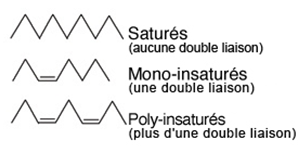
- saturated fatty acids;
- monounsaturated fatty acids, including omega-9;
- polyunsaturated fatty acids, including omega-3 and omega-6.
In chemistry, the terms "saturated", "unsaturated" and "mono- or polyunsaturated" refer to the type of bonds between the carbon atoms in these molecules. A saturated fatty acid has only single bonds between its carbon atoms; an unsaturated fatty acid has one double bond (monounsaturated) or several (polyunsaturated).
Saturated fatty acids are generally found in large proportions in animal products. Diets in developed countries are often too rich in saturated fats, hence the need to look for other sources of fat, richer in unsaturated fatty acids, to restore the balance.
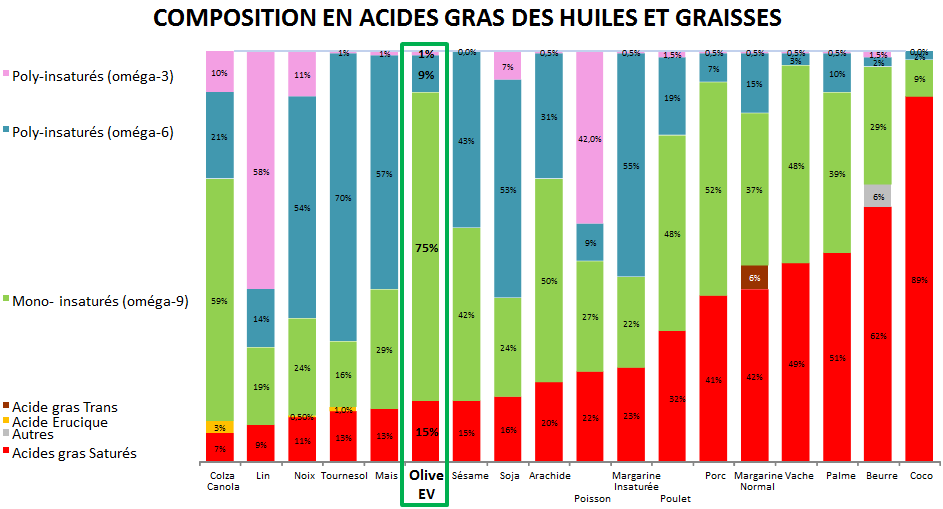
Vegetable oils are often richer in unsaturated fatty acids, with the exception of palm and coconut oils. Olive oil stands out for its relatively low saturated fat content and the highest monounsaturated fat content, in particular oleic acid.
Trans fatty acids
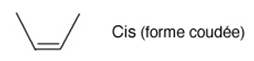
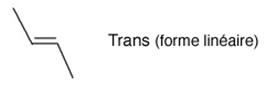
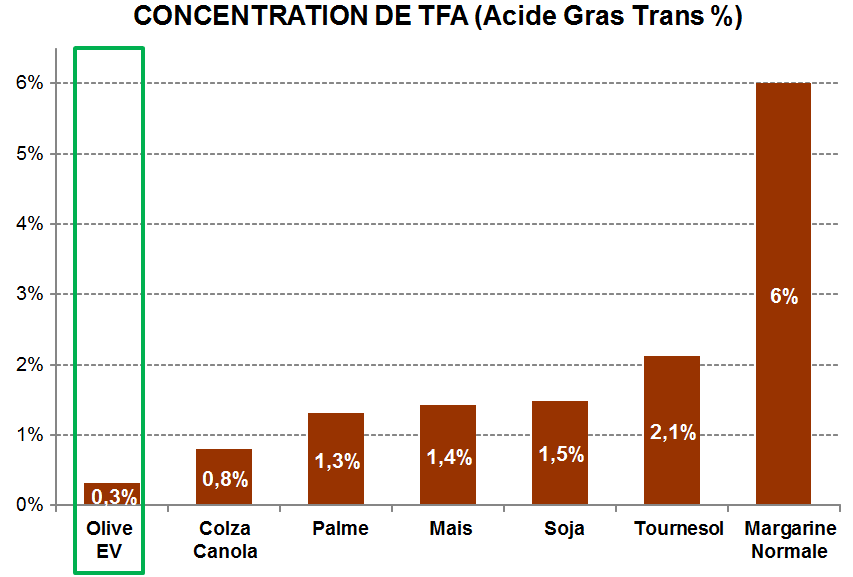
Fatty acids exist in two geometric forms: the cis form, the most common in nature and in food, and the trans form, which is much rarer in natural foods. Present only in tiny amounts in unprocessed foods, trans fatty acids occur naturally in small quantities in the milk and meat of ruminants.
Most of the trans fatty acids we eat, however, come from foods that have undergone industrial processes to solidify vegetable fats: partial hydrogenation. This makes oils richer in saturated fats and therefore less sensitive to oxidation, which produces particular textures and a longer shelf life. Trans fatty acids can also form during the final stage of oil refining, deodorisation. Pastries, cakes, industrial bread products, chocolate bars and biscuits often contain a lot of them.
In 2005, the French food safety agency (AFSSA, now ANSES) showed that trans fatty acids consumed above 2% of total energy intake increase the risk of cardiovascular disease. It is therefore advisable to choose oils and fats that contain practically none, which essentially means vegetable oils obtained by mechanical processes. Extra virgin olive oil is one of the oils that contains the least.
Cooking temperatures
Oils and fats are often used for cooking, for three main reasons:
- they stop food burning and sticking to pans;
- they reach cooking temperatures above the 100 °C possible with water;
- heated above 100 °C, they trigger complex chemical reactions with the amino acids and sugars in food, producing aromatic and flavourful molecules that give cooked food its brown colour and particular taste.
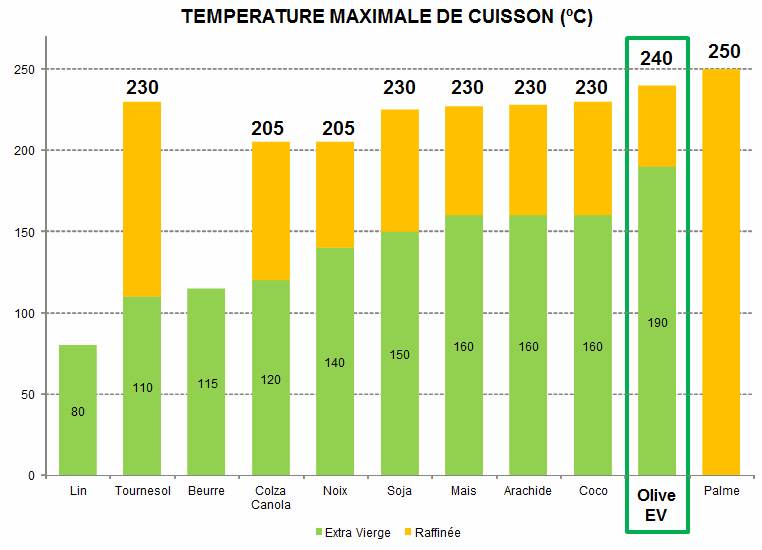
The highest temperature to which an oil or fat can be heated is called its smoke point. Beyond it, the fatty acids break down and undesirable compounds form, some of them carcinogenic: the oil darkens, smokes and tastes very unpleasant.
Chemical refining raises the smoke point of oils and fats, but removes many minor components that are very good for health, such as polyphenols. Extra virgin olive oil has the special quality of combining a particularly high smoke point with a large proportion of beneficial minor components.
Minor components
Unrefined oils and fats contain tiny amounts of components that often have very positive health effects, especially antioxidants.
Extra virgin olive oil contains on average 500 mg/kg of polyphenols. Its main polyphenols are tyrosol, hydroxytyrosol, oleuropein, oleocanthal and lignans. It also contains on average 300 mg/kg of vitamin E. Of the eight forms of vitamin E, it mainly contains the most effective one, alpha-tocopherol.